
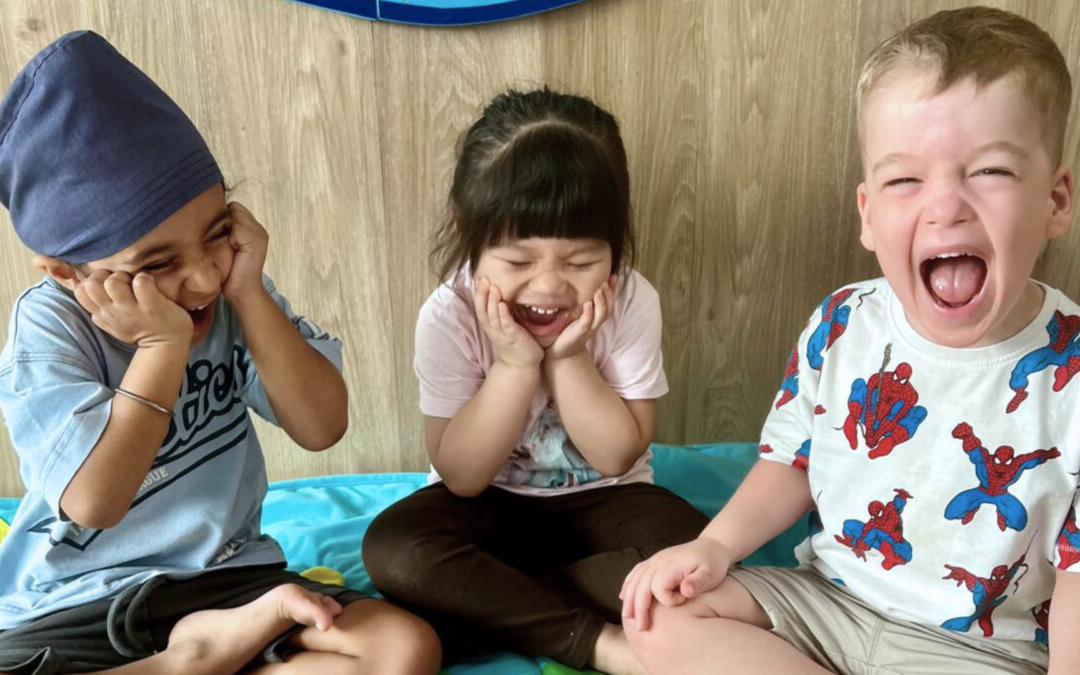
Joy doesn’t usually make it into conversations about education.
We talk about outcomes, and rigour, and readiness. We certainly talk about results. We talk about resilience, grit, focus, and discipline. We even talk about future-proofing children for a world we admit we don’t fully understand yet.
But we rarely hear conversations about joy.
Joy is often treated as a nice bonus — something extra. Something we’ll only allow once the “real work” is done.
And yet, if you step back and really look at how children learn — not how we wish they would, but how they actually do — joy keeps showing up, quietly and consistently, at the centre of it all.
Not the loud, sugar-high kind of joy. Not constant happiness. But a deeper kind: curiosity, engagement, absorption, or just simply a sense of “I want to be here.” In other words, the kind of joy that doesn’t distract from learning, but fuels it. And the kind of joy that we try to preserve in our learners at Imagine If.
Think about the moments when children are most deeply engaged: A child building something again and again until it finally stands on its own. Or a group inventing an elaborate game with rules only they understand. Or someone absorbed in drawing, reading, coding, tinkering, talking with such absorption and investment that they become unaware of time passing.
Schools tend to snuff out such moments, seeing them as unscheduled, chaotic, or frivolous. When really, learners in those moments might be concentrating hard, negotiating with peers, trying something that doesn’t work and trying again. They might even be frustrated. But they’re engaged, present, and invested. Alive.
Contrast that with what disengagement looks like: the glazed stare, the constant sighs of “I’m bored,” the resistance that gets labelled as laziness or defiance. What if we told you that those aren’t signs of children who need more pressure, but are, in fact, signs of children who’ve lost their relationship with learning?
Joy, in this sense, isn’t necessarily about making everything easy or fun. It’s about preserving that relationship: the one where learning feels meaningful enough to stay with, even when it’s hard.
Part of our discomfort with joy in education is cultural. Many of us were raised to believe that worthwhile things are supposed to feel difficult. That effort must look a certain way to count. If a child is enjoying themselves too much, something must be missing, such as rigour, discipline, and seriousness.
There’s also fear underlying this. Fear that if children enjoy learning, they won’t learn how to cope with discomfort. Or a fear that joy makes children soft, a narrative that we encounter in the wider world, time and time again. Fear that without pressure, they’ll fall behind.
So we compromise. We tolerate joy in small doses, but we don’t design for it. We treat it as incidental, rather than intentional.
The irony is that this approach often produces the opposite of what we want. Children don’t become more motivated. They become compliant or burnt out — sometimes both.
From a developmental perspective, joy isn’t solely sentimental. It’s neurological. When a child feels interested, safe, and emotionally regulated, the brain is more receptive to learning. Curiosity activates attention. Engagement strengthens memory. Positive emotional states make it easier to persist through challenges.
This doesn’t mean children should never experience frustration. In fact, frustration is part of learning. But there’s a difference between productive struggle and chronic stress. One builds capacity, while the other shuts it down.
When learning environments rely heavily on pressure, comparison, and constant evaluation, the nervous system stays on high alert. Over time, children learn to associate learning with tension rather than exploration. Joy doesn’t disappear because children are lazy; it disappears because their systems are overwhelmed!
At Imagine If, we treat joy as feedback. When a child is consistently disengaged, it tells us something. When they light up in certain contexts and shut down in others, it also tells us something. And when they oscillate between intense focus and restlessness, it tells us something, too.
Joy is an invaluable tool in helping us understand whether the environment is working for the child, not just academically, but developmentally. This doesn’t mean we chase constant excitement or entertainment. But it means that we pay attention to where children come alive, and why.
Often, we’ve observed that joy appears when children have:
Agency over how they approach a task.
Time to stay with an idea long enough to make sense of it.
Freedom to move, talk, experiment, and adjust.
Relationships that feel collaborative rather than controlling.
None of these are radical ideas. But they’re surprisingly rare in traditional schooling models. It’s not rocket science: when joy is systematically removed from learning, children have to adapt — but not in ways that serve them long-term.
Some become high achievers who learn to perform well while disconnecting from themselves. Others internalise the idea that they’re “bad at learning.” Some comply quietly. Some push back loudly. Many oscillate between the two.
Over time, learning becomes something to endure rather than pursue.
By adolescence, this often shows up as apathy. By adulthood, it becomes a belief that learning is stressful, intimidating, or only for certain kinds of people.
This isn’t a personal failure. It’s a design problem.
One of the biggest misconceptions is that prioritising joy means abandoning structure. In reality, children thrive on structure that makes sense to them with clear boundaries, predictability, and expectations that are fair and flexible rather than rigid and punitive. Joy and discipline are therefore not opposites. Joy without structure can be chaotic. But structure without joy becomes oppressive. The balance matters.
When children are trusted, supported, and taken seriously, they often rise to the occasion. Not because they’re forced to, but because the work feels worth doing. If joy is dismissed as irrelevant in education, it doesn’t disappear. It just gets deferred.
We tell children, “Later. After exams. After school. After you’ve proven yourself.” And then adulthood arrives, and many people realise they’ve forgotten how to learn for themselves: how to follow curiosity, or how to try something new without fear of scrutiny and evaluation. It’s as if we punish learning out of them without realising we’ve done so.
That’s how decoupling joy from learning doesn’t produce more capable adults, but produces anxious ones.
Joy, when taken seriously, teaches children that learning can be something you participate in, instead of something that just happens to you. So yes — we absolutely believe joy is a serious educational outcome. Not the only one. But a foundational one
Because a child who experiences joy in learning is more likely to stay curious, take intellectual risks, and be more likely to persist through difficulty. And more likely to see themselves as capable of growth.
We can’t write this joy off as “indulgence” if it prepares them for the real world.
